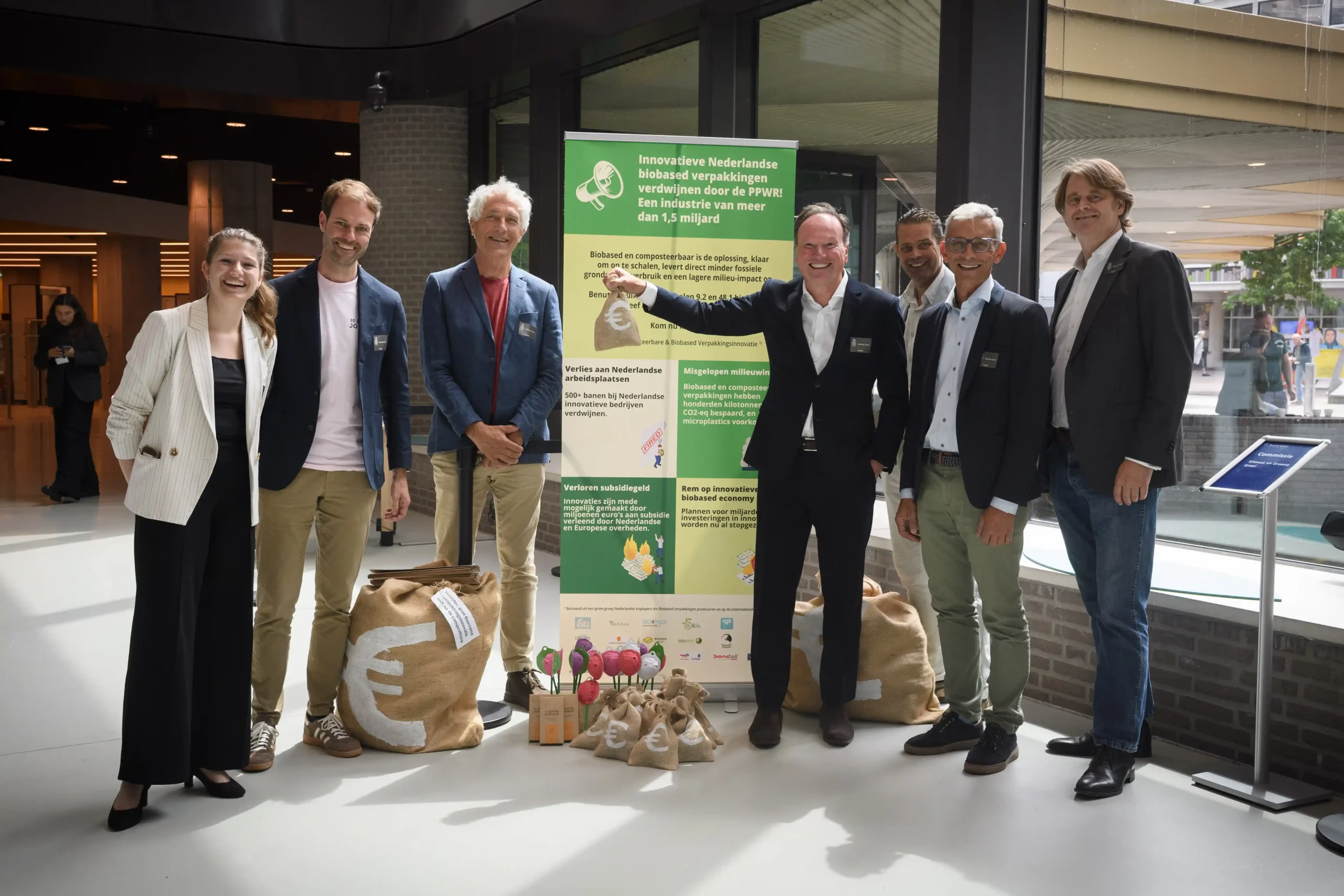
Bio4Pack joins seven fellow packaging companies in calling on the Netherlands to evaluate compostable applications proportionately, before the August 2026 implementation window closes.
THE HAGUE, Netherlands. Bio4Pack, together with seven fellow Dutch packaging companies and industry organisations, today handed a formal petition to the Standing Committee of the Dutch House of Representatives (Tweede Kamer), calling for a proportional, technology-neutral national implementation of the EU Packaging and Packaging Waste Regulation (PPWR).
The petition was delivered at the Parliament in The Hague. Representatives present included Bio4Pack, Bio4Life, PaperFoam, De Koffiejongens, Ekopackgroup, Van Oort & Van Oort, Verpakkingsunie Nederland, and Advanced Technology Innovations.
The problem with the current direction
The petition argues that the current trajectory of Dutch PPWR policy risks excluding compostable and biobased packaging, even in applications where composting delivers better environmental outcomes than recycling.
Not all packaging is technically or hygienically recyclable. Food contamination blocks high-quality material recovery. Reuse is not ecologically efficient in every context. For several material streams, the practical end point is incineration or downcycling regardless of how the system is designed.
The Netherlands already operates one of Europe’s most mature organic waste (GFT) collection and processing infrastructures. Compostable packaging can use that route today, without new infrastructure. Policy that doesn’t account for this is ruling out solutions that already work.
The coalition is asking for an approach that assesses each application on actual environmental and system performance, using objective criteria: food contamination levels, technical recyclability, CO2 impact, available processing capacity, and contribution to residual waste reduction.
What the petition asks for
Before August 12, 2026, the coalition calls on parliament and cabinet to assess the following specific applications under PPWR Article 9(2), which gives member states discretion to evaluate composability requirements for designated product categories:
- Foodservice packaging (PPWR Annex V categories 3 and 4)
- Fruit and vegetable packaging (category 2)
- 100% natural materials (such as mycelium-based packaging) recognised as compostable by definition
Coffee capsules and very thin plastic bags are listed for consideration by 2028, depending on recycling performance in the interim.
The coalition is also calling for a review of EPR tariff structures for biobased and biodegradable packaging, in consultation with Verpact and sector stakeholders.
Finally, the coalition wants industry involved in policy decisions while positions are still being shaped, not once they have been set.
Patrick Gerritsen, CEO of Bio4Pack: “The PPWR gives member states real room to make proportional choices. The Netherlands has the collection infrastructure, the material expertise, and the sector capacity to make compostable packaging work at scale. What’s missing is policy that reflects that. That is what we are asking parliament to act on, specifically before August.”
The coalition
The petition was coordinated by Verpakkingsunie Nederland and presented by representatives from:
- Bio4Pack (compostable and biobased packaging consultancy and distributor)
- Bio4Life (biobased materials specialist)
- PaperFoam (plant-based packaging manufacturer)
- De Koffiejongens (coffee and foodservice operator)
- Ekopackgroup (sustainable packaging distributor)
- Van Oort & Van Oort (public affairs and communications)
- Advanced Technology Innovations (packaging technology)
- Verpakkingsunie Nederland (Dutch packaging industry association)
About Bio4Pack
Bio4Pack is a European packaging consultancy and distributor specialising in compostable and biobased packaging. It works with food brands, FMCG companies, and foodservice operators across Europe to select certified compostable packaging that meets current and forthcoming regulatory requirements, including the PPWR. Bio4Pack provides both product supply and expert guidance on compliance, material selection, and transition planning.